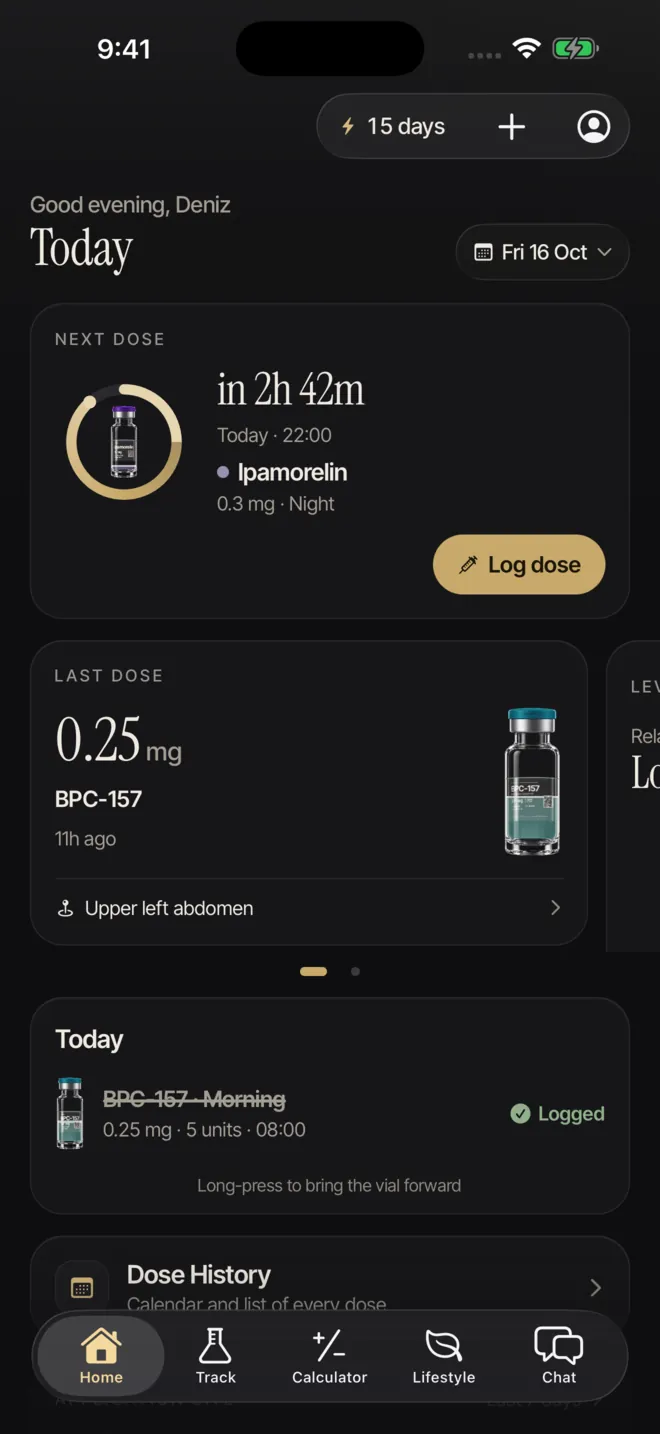
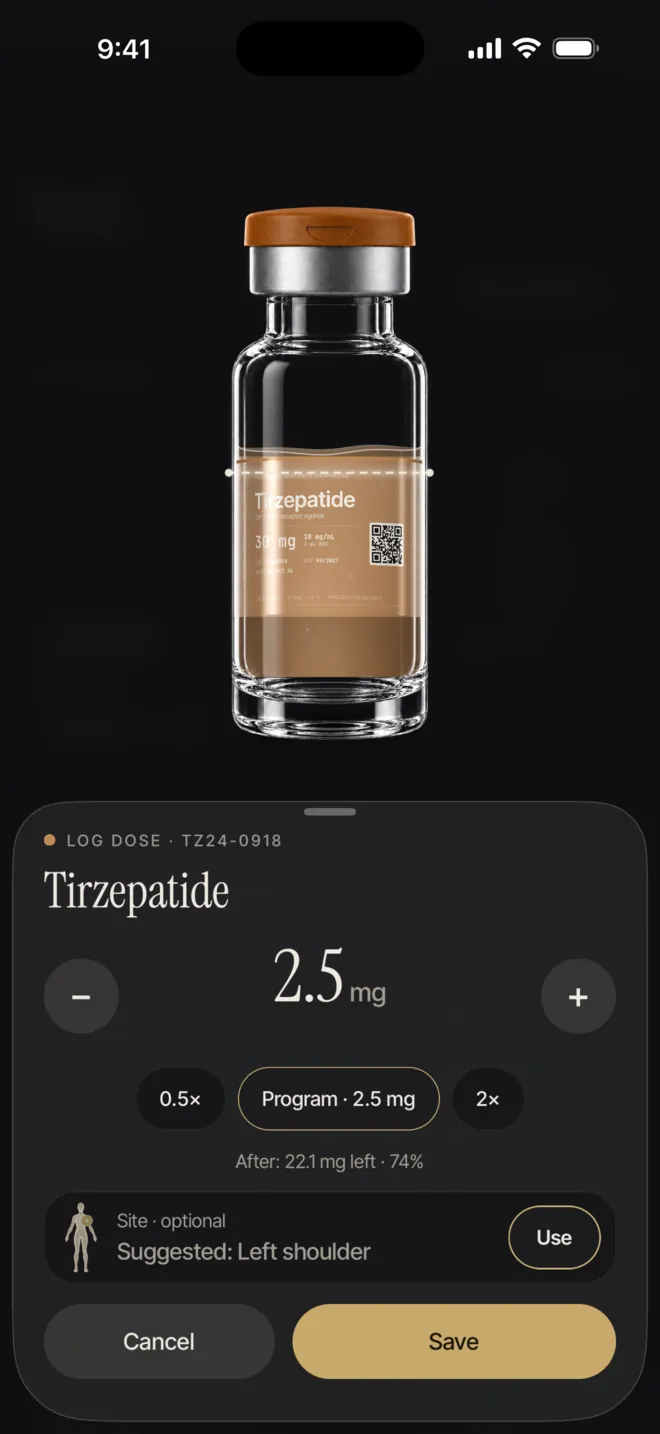
What makes PepLabo a better Phaze alternative?
Phaze and PepLabo agree on more than most trackers do: both keep records on the phone and neither asks you to log in. The differences begin where a GLP-1 pen ends and a powder vial begins.
Built for peptides as well as GLP-1 medicines
In PepLabo, a program can hold any compound from its list, whether it is a branded GLP-1 or a peptide that has never had a pen. The dose, the vial, the site and the schedule work the same way for each of them.
Phaze’s listing names semaglutide, tirzepatide and orforglipron medicines and adds an Other option for any injectable or oral GLP-1 [1]. Its level chart is based on typical absorption patterns [1]. PepLabo’s estimated level chart uses a half-life you enter from your own source instead, so the chart works the same way for a peptide as for a GLP-1. It is a picture of your own log, never medical advice.
Bottom line: if what you inject goes beyond GLP-1 medicines, PepLabo treats every compound as a first-class program.
From the powder vial to syringe units
A peptide often arrives as powder. PepLabo’s calculator takes the amount in the vial, the water you added and the dose you were prescribed, and shows the units to draw on an insulin syringe. Save the vial and every logged dose comes off it, so you see the level dropping well before the vial is empty. All of this is on the free plan.
Phaze lists supply, expiry and run-out as Pro features [3]. We did not find a reconstitution calculator or syringe units in its listing or on its website [1][3].
Bottom line: PepLabo puts the mixing math and the vial stock in one free place, next to the dose they belong to.
Cycles and several programs, side by side
A peptide routine may be planned in blocks: a stretch on, a stretch off, a week or two of rest, then the next round. PepLabo keeps each program separate, with its own schedule, its own on and off periods and its own weeks off, and it records the site with every dose so rotation stays visible across all of them.
Phaze’s dose cycle ring shows where you are between one shot and the next [1][3], which is a different idea. We did not find planned on-and-off cycles in its sources, and more than one medication is a Pro feature there [1][3].
Bottom line: when your routine has structure beyond a weekly shot, PepLabo keeps that structure intact.
Reminders that move with your clock
PepLabo can remind you before a dose, at the time and once more if nothing has been logged, so a late dose is noticed rather than forgotten. A few hours after a dose it can also ask how you feel, which turns side-effect notes into a habit instead of a chore.
Travel mode on Pro asks for your destination time zone and how you want to handle the shift, then moves your dose reminders to match. Phaze’s site describes a different tool: pausing streaks while you travel, feel unwell or wait on a refill [3]. That protects the streak; PepLabo moves the reminder itself.
Bottom line: PepLabo keeps the timing of the dose right when your clock changes, not only the streak.
Side effects tied to a specific dose
PepLabo’s check-in records energy, sleep, mood, symptoms and an overall severity, and you can link it to a dose from the last 72 hours. Over a few weeks that shows which dose came before a rough day, which is the question a clinician tends to ask first.
The link works after the fact too: a symptom that shows up a day later can still be attached to any dose logged in the 72 hours before it, so the record points back to the right shot.
Bottom line: PepLabo turns side-effect notes into a record that points back to the dose behind them.
Your whole record in a file, doses included
Both apps keep records on the phone. Phaze encrypts medical data on the device and writes a daily encrypted backup to your own iCloud Drive [3]; its JSON export on iPhone, though, leaves medical fields out [3]. PepLabo’s export, free for everyone, includes everything you logged: doses, sites, vials, side effects and weight.
PepLabo also has no analytics, advertising or tracking SDKs at all. Phaze says medication details are stripped from its analytics [3]. You only sign in to PepLabo for Pep AI, which shows what it will send before your first message and never sends dose amounts.
Bottom line: if you want a complete copy of your injection history that you control, PepLabo hands you one for free.
Recovery data from WHOOP
PepLabo Pro reads sleep, recovery, HRV, resting heart rate, workouts and strain from WHOOP, and steps and weight from Apple Health on iPhone or Health Connect on Android. Everything is read only, and it sits next to your doses, so a poor night after a dose change is easy to spot.
Phaze connects to Apple Health with a switch per metric [1]. We did not find WHOOP in its sources [1][2][3].
Bottom line: with a WHOOP strap, PepLabo brings your recovery data into the same view as your doses.
Where Phaze is still better
Phaze is a carefully made GLP-1 tracker, and in a few areas it reaches further than PepLabo:
- An Apple Watch app with complications, plus Siri, CarPlay and StandBy on iPhone [1][3].
- An iPad app and a version you can try in a web browser [1][3].
- A free PDF report and a free encrypted iCloud backup that lists every copy [3].
- A community in eight languages with every post translated, open for your first seven days and then part of Pro [1][3].
- Lab entry on the free plan, and lab document scans, DEXA import and body composition on Pro [3].
Bottom line: PepLabo pulls ahead in a different situation: when vials, reconstitution and cycles are the part of the routine you cannot afford to get wrong.
Same price, different things on the free plan
Phaze’s website lists Pro at $9.99 a month or $59.99 a year [3], the same as PepLabo Pro in the US. What differs is what each app keeps free.
PepLabo’s free plan covers the injection routine: dose logging, reminders, vials, injection sites, the reconstitution calculator and the research library. Pro, with 3 days free on the yearly plan for eligible new subscribers, adds access to Pep AI chat, meal estimates from a photo, voice or restaurant menu, Apple Health, Health Connect and WHOOP data, widgets, travel mode and PDF reports.
Phaze’s free plan includes dose tracking for your first medication, food search and scans, site rotation, My Report, Watch, widgets, Apple Health and the iCloud backup; more medications, supply, AI meal logs, Ember and Community after seven days are on Pro [1][3].
Bottom line: if your routine depends on vials and unit math, PepLabo’s free plan already covers what Phaze either places in Pro or does not list.
PepLabo next to Phaze, or in its place
Both apps log GLP-1 doses, so tracking the same medicine twice adds work without adding anything. A cleaner split is by compound: keep a GLP-1 in Phaze if its Watch app is part of your day, and move peptides from powder vials to PepLabo, where the calculator and the vial stock live.
If you would rather have a single place, PepLabo can hold the GLP-1 and the peptides together, each as its own program with its own schedule, sites and vial. The two apps do not share data, and there is no direct import from Phaze.
Bottom line: split by compound if the Watch matters to you, or move everything to PepLabo once vials are part of the routine.
Overall
Phaze is one of the more complete GLP-1 trackers, with a Watch app, a web version, a community and a generous free plan. PepLabo is the better choice once the routine involves more than a pen: peptides alongside GLP-1 medicines, powder vials that need mixing and tracking, cycles with planned breaks, reminders that follow a new time zone and a full export of your own records. Both respect your privacy; PepLabo is the one built around the vial.
Trademarks and sources
Phaze is a trademark of ZEIT TECNOLOGIA LTDA. PepLabo has no affiliation with ZEIT TECNOLOGIA LTDA. Everything said here about Phaze comes from its public App Store listing, Google Play page and website, read on 20 October 2026, and may have changed since. “Not mentioned in the sources we read” means we could not confirm a feature there, not that the app lacks it.