Out-of-fridge limits, label by label
Every GLP-1 product has its own storage rule, and the room-temperature allowance is what matters most on a trip. The table restates each US label; the date that applies is the one for the pen, vial or bottle you actually carry.
| Product | Before first use | Away from the fridge, as the label allows | Section |
|---|---|---|---|
| Ozempic® pen [1] | Refrigerator, 2–8°C | After first use: 56 days at 15–30°C or in the fridge | 16 |
| Wegovy® single-dose pen or syringe [2] | Refrigerator, 2–8°C | If needed, before the cap comes off: up to 28 days at 8–30°C | 16 |
| Wegovy® FlexTouch® pen [2] | Refrigerator, 2–8°C | After first use: 56 days at 15–30°C or in the fridge | 16 |
| Mounjaro® / Zepbound® single-dose pen or vial [3][4] | Refrigerator, 2–8°C | If needed: up to 30°C for a total of 21 days | 16.2 |
| Mounjaro® / Zepbound® KwikPen® or multi-dose vial [3][4] | Refrigerator, 2–8°C; 30 days if kept up to 30°C unopened | Once opened: fridge or up to 30°C; discarded after 30 days at room temperature, 30 days from first use or 4 weekly doses | 16.2 |
| Trulicity® pen [5] | Refrigerator, 2–8°C | If needed: up to 30°C for a total of 14 days | 16.2 |
| Victoza® / Saxenda® pen [6][7] | Refrigerator, 2–8°C | After first use: 30 days at 15–30°C or in the fridge | 16 |
| Rybelsus® / Ozempic® tablets [8] | Room temperature, original bottle | 20–25°C, short spells of 15–30°C allowed | 16 |
| Wegovy® tablets [2] | Room temperature, original bottle | 20–25°C, short spells of 15–30°C allowed; keep dry | 16 |
| Foundayo™ tablets [9] | Room temperature | 20–25°C, short spells of 15–30°C allowed | 16.2 |
Heat, cold, light and the car
The injectable labels agree on one thing: the medicine must not be frozen, and a pen or vial that has frozen is not used [1][2][3][5]. The Mounjaro® and Zepbound® labels add protection from heat and light and keeping the medicine in its carton, and the Ozempic®, Victoza® and Saxenda® labels ask for protection from excessive heat and sunlight [1][3][4][6][7].
Two instruction leaflets speak to travel directly. The Ozempic® Instructions for Use ask you to keep the pen with you and not leave it in a car or anywhere that could get very hot or very cold [1]. The Victoza® instructions say a pen carried away from home is kept at room temperature, 15–30°C [6].
A pen dispensed in Europe can carry different numbers. The EU product information for Ozempic® gives an in-use life of 6 weeks for the 4-dose pens and 8 weeks for the 8-dose pens, below 30°C or in a fridge [10]. The leaflet in your box is the one to follow.
 Open larger screen
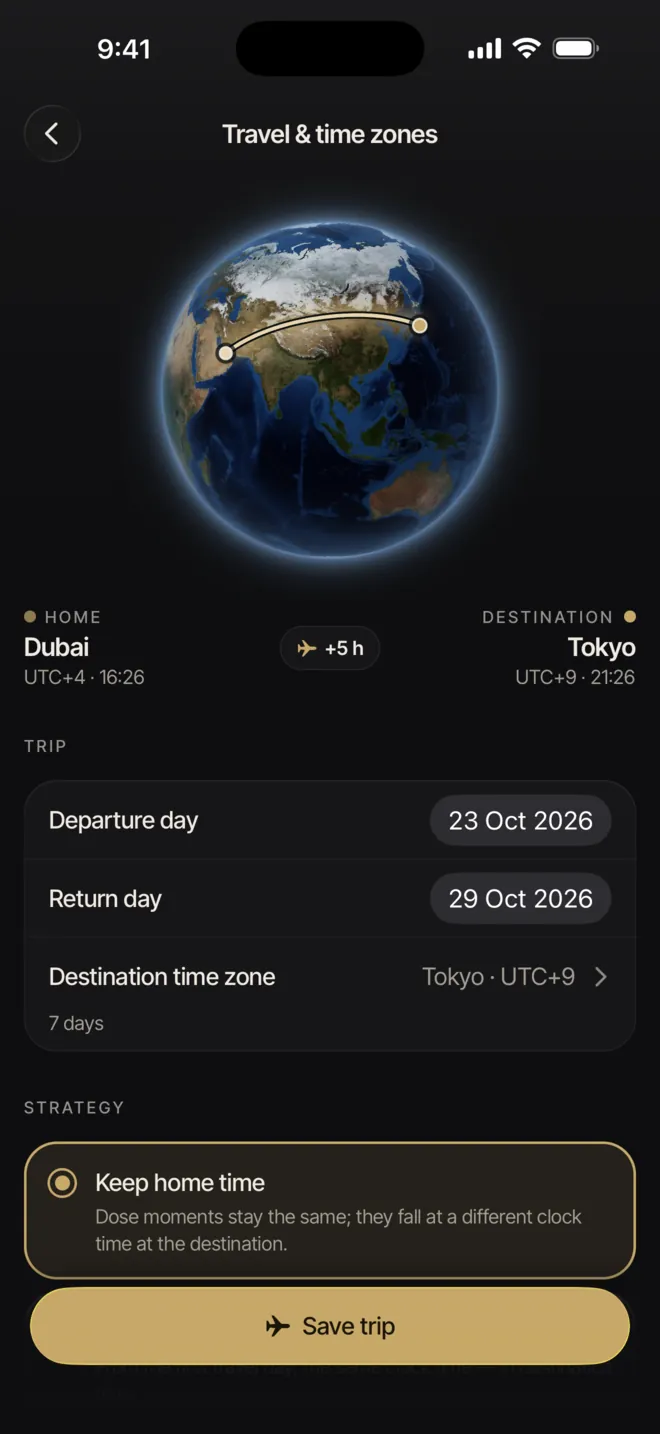
Time zone settings for a trip.
 Open larger screen
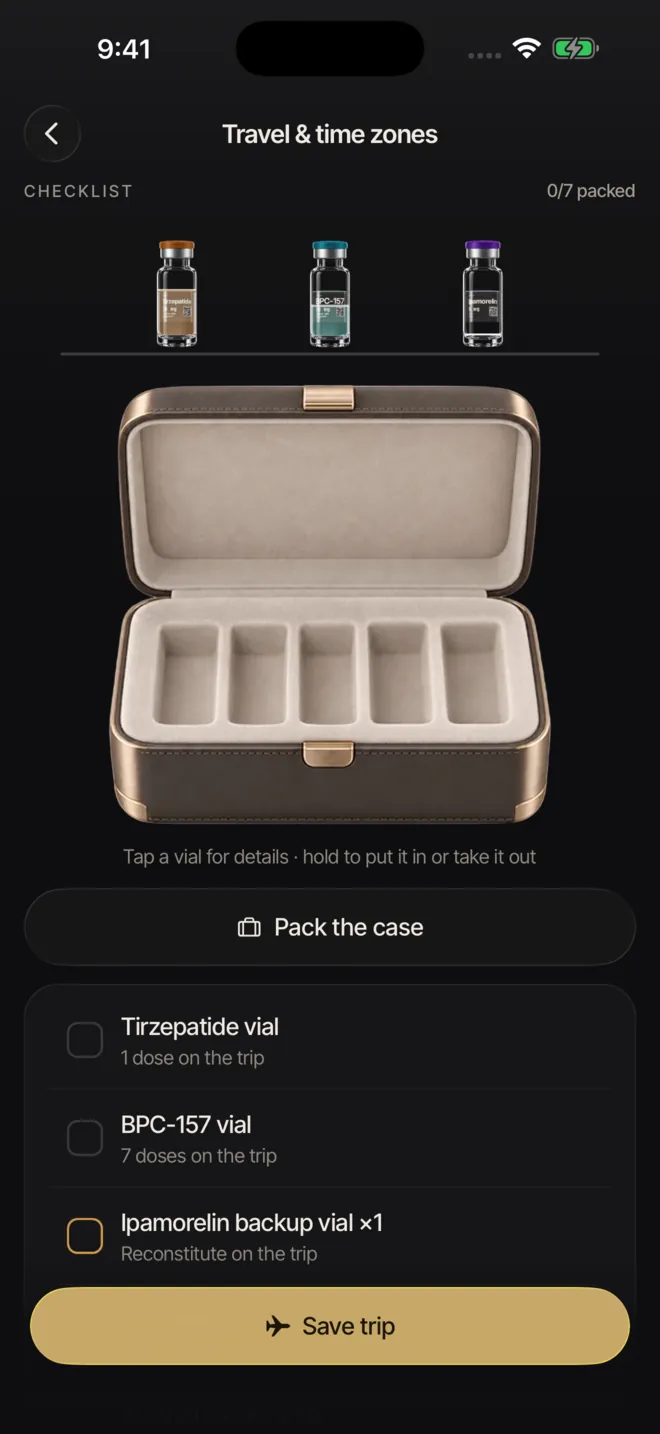
The packing checklist for a trip.
Packing: spares, needles and paperwork
- Spares: the Ozempic® instructions ask you to carry an extra pen and new needles in case one is lost or damaged [1].
- Needles: the Ozempic® and Wegovy® FlexTouch® labels use a new needle for every injection and store the pen with no needle attached; for vials, the Mounjaro® and Zepbound® labels use a new syringe and needle every time [1][2][3][4].
- Carry-on: the CDC suggests keeping medicines in your hand luggage in case a checked bag is lost or delayed, and packing enough for the whole trip plus extra for delays [14].
- Labels and papers: the CDC suggests original containers labelled with your name, the prescriber, the generic and brand names and the dose, copies of written prescriptions, and a note from your prescriber for injectable medicines [14]. The FDA adds that a pharmacy label or the manufacturer’s label and a doctor’s letter make airport screening easier [11].
At US airport security
The TSA allows unused syringes when they travel with injectable medication, in both carry-on and checked bags, as long as you declare them at the checkpoint; labelling the medicine is advised but not required [12]. Used syringes are allowed in a sharps disposal container or a similar hard-surfaced container [12].
Medically necessary liquids above the usual liquid limit are allowed in reasonable quantities for the trip. Tell the officer before screening starts and place the medicine, with any freezer packs and syringes, in a separate bin [13]. Ice packs, freezer packs and gel packs may be presented frozen, partly frozen or melted. If you do not want a liquid medicine X-rayed or opened, say so; it will be cleared another way, and you can expect extra screening [13]. The final call on any item rests with the officer [12].
Crossing borders
Rules outside the US are set by each country. The CDC notes that medicines common in the US can be unlicensed or controlled elsewhere, that many countries allow about a 30-day supply but may require a prescription or medical certificate, and that it is worth checking with the embassy of your destination and of any layover country [14].
For trips longer than 30 days, the CDC suggests asking your provider how to get enough medicine, since some insurers pay for only 30 days at a time [14]. It also warns that counterfeit medicines are common in some countries and suggests using only medicine brought from home [14].
Used needles away from home
The FDA’s two steps apply on the road as at home: a used needle goes straight into a sharps container kept away from children and pets, and the container is disposed of by local rules when it is about three-quarters full [11]. Because other options may not be available, the FDA suggests always carrying a small, travel-size sharps container [11].
Disposal rules vary from place to place. The Ozempic® instructions add that a used sharps container is not put in household trash unless local guidelines allow it, and is not recycled [1]. The sharps disposal article covers collection sites and mail-back programmes.
Your weekly dose across time zones
- Moving the weekly day: the Ozempic® label and the Wegovy® Medication Guide allow it when the previous dose was at least 2 days earlier; the Mounjaro®, Zepbound® and Trulicity® labels when it was at least 3 days (72 hours) earlier [1][2][3][4][5].
- A dose missed on the road: Ozempic® within 5 days, Mounjaro® and Zepbound® within 4 days (96 hours); Wegovy® injection if the next dose is more than 2 days away; Trulicity® if at least 3 days remain. Otherwise the labels skip it and resume on the usual day [1][2][3][4][5].
- Two or more Wegovy® injections missed in a row: the label restarts escalation at a lower dose, and the Medication Guide asks you to contact your provider about restarting [2].
- Clock time versus elapsed time: the CDC’s general advice is that medicines are timed by the hours since the last dose rather than the local clock, and that changes for a new time zone are agreed with your provider [14].
If you get sick on the trip
A stomach bug abroad matters more on a GLP-1. The Wegovy® and Zepbound® labels describe acute kidney injury, mostly in people whose nausea, vomiting or diarrhoea led to dehydration, and the Wegovy® Medication Guide stresses drinking fluids and telling your provider right away about stomach symptoms that do not go away [2][4].
If you also use insulin or a sulfonylurea, the labels describe a higher risk of low blood sugar, and long travel days with skipped meals are worth raising with your prescriber in advance [2]. The CDC suggests a travel health kit with the prescription and over-the-counter medicines you use, since some items are hard to find abroad; which ones suit you is a question for your pharmacist [14].
Ozempic®, Wegovy®, FlexTouch®, Rybelsus®, Victoza® and Saxenda® are registered trademarks of Novo Nordisk A/S. Mounjaro®, Zepbound®, KwikPen® and Trulicity® are registered trademarks and Foundayo™ is a trademark of Eli Lilly and Company. PepLabo is not affiliated with or endorsed by Novo Nordisk or Eli Lilly and Company.
When to get help
The signs and contact information below come from this article’s sourced guidance.
Today
- Nausea, vomiting or diarrhoea that does not go away, especially with signs of losing fluids
Contact: Your prescriber, right away
Wegovy® Medication Guide; label section 5.5 [2]
- Severe stomach pain that will not go away, with or without vomiting, sometimes reaching the back
Contact: Your prescriber, right away
Wegovy® Medication Guide; label section 5.2 [2]
- Dizziness, sweating, shakiness or confusion while also taking insulin or a sulfonylurea
Contact: Your prescriber
Wegovy® label, section 5.4; Medication Guide [2]
At your next appointment
- Two or more weekly Wegovy® doses missed in a row while away
Contact: Your prescriber, before restarting
Wegovy® label 2.4; Medication Guide [2]